What makes a trading card collection feel personal, not just valuable
It is easy to measure a collection by value. A price chart gives a number. A grade gives a number. A sale gives a number. Those things matter, especially when cards become expensive enough to insure, trade, or pass on. But value is not the same as meaning.
The collections people keep returning to usually have something else: a point of view. They feel like someone chose them, not just bought them.
Value is only one language
A valuable card can be important. It can mark a player, a set, a character, a year, or a moment in the hobby. But if price is the only reason a card is in the collection, the collection can start to feel borrowed from the market. It changes every time the market changes.
A personal collection has a different center. It can include valuable cards, but it is not held together by value alone. It is held together by taste, memory, curiosity, and use.
That is why two collectors can own cards from the same set and still have completely different collections. One is chasing complete runs. One is collecting a player. One cares about art. One keeps the cards they pulled themselves. One wants only clean copies. One wants cards with a story.
None of those choices is wrong. The important part is knowing which choice is yours.
Start with why the card belongs
A personal collection is easier to build when every card has a reason to be there. The reason does not need to be grand. It can be simple:
- You pulled it yourself.
- You loved the artwork as a child.
- It reminds you of a player, season, game, or person.
- It completes a page or set.
- It represents a design era you care about.
- It is the best condition copy you could reasonably find.
- It is not expensive, but it makes the binder feel right.
The reason is what turns ownership into collecting. Without it, cards accumulate. With it, they start to relate to each other.
A good collection has edges
The strongest collections usually have limits. Limits make choices clearer. They stop the collection from becoming everything at once.
You might collect one era, one character, one player, one set, one language, one grade range, one type of artwork, or one theme. You might decide to avoid hype releases, avoid cards you would not keep raw, or only buy cards that improve a page you already care about.
This is not about making the collection smaller for the sake of it. It is about making it more deliberate. A binder with fifty cards chosen well can feel more complete than a room full of cards bought without direction.
We touched on this in how to build a trading card collection you’ll still love in 10 years: the collection should feel lighter and clearer with time, not heavier.
Condition matters, but not always in the same way
Some cards deserve condition discipline. If you are collecting valuable rookies, rare foils, vintage cards, or cards you may grade later, condition is part of the object. Corners, centering, surface, and edges matter because they affect both value and long-term care.
But not every personal card needs to be perfect. A childhood card with whitening can still be the most important card in a binder. A lower-grade vintage card can be more satisfying than no copy at all. A card with honest wear may carry the history that makes it worth keeping.
The useful question is not always, “Is this the best copy?” Sometimes it is, “Is this the right copy for this collection?”
That distinction keeps collecting human.
The way you keep it becomes part of the collection
Storage is not only protection. It shapes how you experience the cards. A stack in a box is different from a binder you can open. A graded slab wall is different from a set arranged page by page. A single card on display says something different from a complete run kept quietly in the dark.
The right format depends on the collection:
- A set collection often feels best in binder pages, where the sequence matters.
- High-value singles may belong in slabs, rigid holders, or a smaller protected case.
- Favourite cards can be rotated for display rather than exposed permanently.
- Cards with sentimental value may deserve a dedicated page, even if they are not worth much.
A personal collection should be easy to revisit. If you never open it, it becomes inventory. If it is handled carelessly, it becomes vulnerable. The balance is protection you can actually live with.
Pages can tell a story
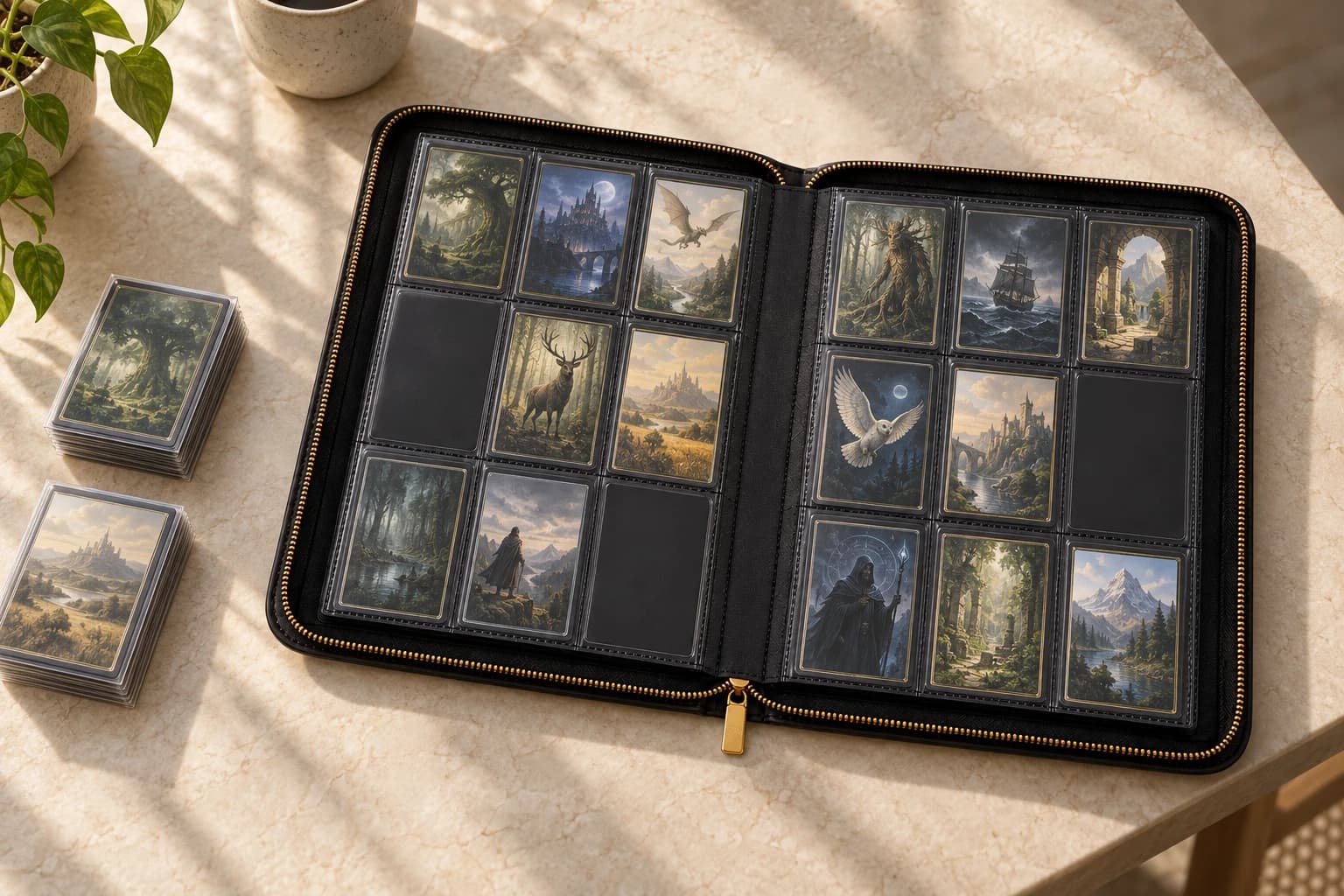
A binder page is a small composition. Nine pockets can show a set run, a colour theme, a player’s career, a favourite evolution line, a season, or a simple group of cards that look good together.
This is where personal collecting becomes visible. Page order, empty spaces, duplicates, variations, and odd choices all reveal taste. A market list will not tell you to place one modest card beside another because the colours speak to each other. A collector will.
Leave room for those decisions. Not every page needs to be optimized for value. Some pages should just feel right.
Keep records without turning the collection cold
A collection can be personal and still be documented. In fact, records often protect the personal side because they make the collection easier to understand later.
Keep a simple list of important cards, where they are stored, what you paid, condition notes, and any story attached to them. For graded cards, include the certification number. For sentimental cards, include why they matter.
That last part is easy to skip, but it may be the most useful note years from now. Value can often be researched later. Meaning is harder to reconstruct.
Edit with care
Collections change. Taste sharpens. Some cards that once felt essential stop belonging. Selling or trading those cards is not a failure. It is part of making the collection more honest.
The mistake is editing only by price. If the market rises, you may be tempted to keep cards you no longer care about. If the market falls, you may be tempted to dismiss cards that still mean something. Neither number tells the whole truth.
Ask what you would miss if the card left. Ask whether the collection becomes clearer without it. Ask whether the card belongs to your taste or only to a trend.
A personal collection is not the most expensive version of your cards. It is the most honest version.
Make it worth opening
The best collections invite you back. They have a rhythm, a reason, and a few surprises. They protect the cards without hiding the feeling that made you collect them in the first place.
Value will always be part of the hobby. It should be respected, especially when cards become meaningful assets. But a collection that is only valuable can feel strangely thin. A collection that is personal has more to hold onto: memory, taste, restraint, and care.
That is the part no price guide can build for you.