How to build a trading card collection you’ll still love in 10 years
The easiest collection to build is the one that follows noise. A card spikes, a set gets talked about, a creator says something is underpriced, and suddenly the collection starts to look less like yours and more like everyone else’s feed. That can be exciting for a while. It rarely lasts.
A collection you still love in ten years is built differently. It has taste. It has a point of view. It has room for memory, not just market value. It is protected well enough to survive time, but it is also edited well enough that you still want to open it.
This is not a guide to buying the most expensive cards. It is a guide to building a collection that keeps meaning.
Start with a reason, not a checklist
Every good collection has a quiet rule behind it. Maybe you collect the first generation of Pokémon because it was your childhood. Maybe you collect one athlete, one illustrator, sealed promos, Japanese exclusives, rookie cards, or cards with a specific visual language. The rule does not need to impress anyone else. It just needs to help you say yes and no.
Without a rule, every card looks like a maybe. With one, the collection starts to sharpen.
Try writing one sentence before the next card comes in:
- I collect cards that connect to a specific era.
- I collect one character, player, team, or artist deeply.
- I collect cards that are beautiful enough to display.
- I collect cards I would still keep if the price went to zero.
That last line is useful. It removes a lot of noise.
Buy slower than the market wants you to
The market rewards urgency. Good collecting usually rewards patience. If you feel rushed, step back for a day. The best cards tend to come around again, and the ones that do not are rarely worth panic-buying without a clear reason.
A simple rule helps: keep a short want list, not an endless one. Ten cards, maybe twenty. When a new card catches your attention, it should earn a place on that list before it earns your money. If it still feels important a few weeks later, it probably belongs. If the feeling fades, you saved yourself a future card you would eventually have to sell, trade, or ignore.
The goal is not to miss everything. The goal is to stop mistaking excitement for conviction.
Choose condition deliberately
Condition matters, but perfection is not always the point. A flawless graded card can be the right choice for a grail. A clean raw copy can be better for a binder. A slightly played childhood card might mean more than a gem mint version with no story attached.
Decide what condition means for each part of the collection:
- Grail cards: buy the best condition you can comfortably afford, with patience.
- Binder cards: prioritise clean fronts, good corners, and cards you enjoy seeing together.
- Sentimental cards: protect them properly, even if they are not financially valuable.
- Speculative cards: keep the position small enough that it does not distort the whole collection.
A mature collection can hold all four, but it should not confuse them.
Organise for the way you actually look at cards
Some collectors organise by set number. Some by player, character, colour, era, illustrator, value, or story. None of those systems is wrong. The wrong system is the one you never use.
If you like completion, organise by set. If you like beauty, organise visually. If you like memory, organise by era. If you like value control, keep high-value cards in their own section and track them carefully.
What matters is that the system is stable enough to grow. Leave space at the end of each section. Label binders. Keep a simple master list. Note where each important card lives. It does not need to be complicated; a spreadsheet with card name, set, condition, value range, binder, and page is enough.
For practical setup, the Kizuna Kin guide to storing a card collection in a binder goes deeper into systems that work as a collection grows.
Protect the collection before it becomes valuable
A strange mistake many collectors make is waiting until a card is expensive before protecting it properly. By then, it may already have edge wear, binder pressure, surface scratches, light fade, or humidity curl. Protection should begin when the card enters the collection, not once the market notices it.
The basics are simple:
- Sleeve cards before they go into pages.
- Use archival, PVC-free pages and holders.
- Avoid direct sunlight and hot rooms.
- Keep humidity stable.
- Handle cards by the edges with clean, dry hands.
Preservation institutions make the same point in more formal language. The Library of Congress warns that paper collections are vulnerable to poor handling, light, humidity, heat, pests, and unstable storage conditions. Its care guidance for works on paper and light exposure is not written for trading cards specifically, but the principle carries over: paper and ink age faster when the environment is careless.
For the card-specific side, read the Kizuna Kin guide to storing trading cards long-term and the guide to protecting expensive trading cards.
Keep the best cards visible enough to enjoy
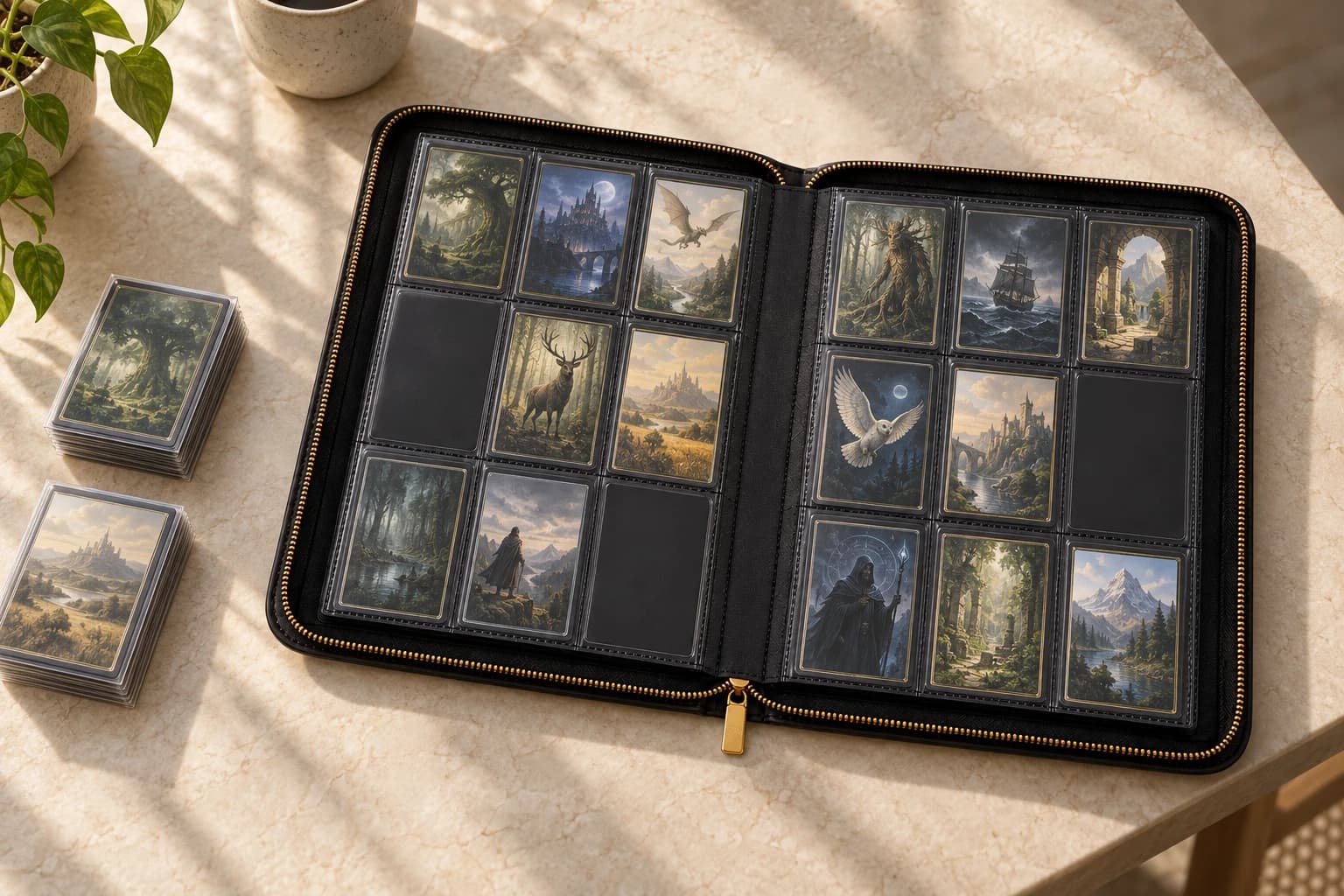
A collection hidden too deeply becomes inventory. Protection matters, but so does access. The best storage system is one you actually open: a binder that turns cleanly, a box that is labelled, a display that is rotated and kept away from direct light.
This is where restraint helps. If every card is treated like a centrepiece, none of them feels special. Give the strongest cards space. Let a page breathe. Build small sections that tell a story: the first cards you loved, the art style you keep returning to, the player’s career arc, the set that changed your taste.
A good binder page is not only storage. It is a small exhibition.
Separate memory from market
There is nothing wrong with caring about value. Many cards are expensive, and ignoring that would be naive. But if every decision is market-led, the collection becomes restless. You will always be tempted to replace, flip, upgrade, or chase the next thing.
It helps to divide the collection into three groups:
- The permanent collection: cards you do not plan to sell unless life forces it.
- The flexible collection: cards you enjoy, but would trade for something more important.
- The market box: cards bought mainly because of price, opportunity, or timing.
This keeps the heart of the collection safe from constant negotiation. It also makes selling easier. You are not asking, “Do I like this?” every time. You already know which role the card plays.
Edit without regret
A ten-year collection will change. Your taste will change. The market will change. Your space, budget, and attention will change. Editing is not failure; it is how a collection stays alive.
Once or twice a year, open everything and ask:
- Would I buy this card again today?
- Does it still fit the reason I collect?
- Is it stored in the right place?
- Would another collector value it more than I do now?
If the answer is no, move it on carefully. Sell it, trade it, gift it, or move it into bulk. The point is not to make the collection smaller for the sake of being minimal. The point is to keep the collection honest.
Build something someone can understand
The most memorable collections have a shape. Someone can open them and understand the person behind them. They are not random accumulations of value. They have themes, pauses, surprises, and a few cards that clearly matter more than the rest.
That is the standard worth aiming for: not the largest collection, not the loudest, not the most expensive. A collection with a point of view. One that still feels like yours after the hype cycles have moved on.
Buy with patience. Protect from the start. Organise so you can find things. Edit when the collection starts to drift. Keep the cards that carry a real bond.
Ten years from now, those are the ones you will still want to open.