How to display trading cards without fading or damaging them
A card kept in the dark is easy to protect. A card on display asks for more care. Light reaches it. Dust settles around it. Temperature changes faster near windows and shelves. People point at it, pick it up, and move it. None of that means cards should never be displayed. It means display should be treated as a controlled choice, not permanent storage.
The aim is simple: show the card without making it pay for being seen.
The main risk is light
Light is the one kind of display damage you cannot undo. Ultraviolet light breaks down pigments and paper surfaces over time, which leads to fading, yellowing, and a duller finish. Direct sunlight is the worst case, but bright indirect daylight can still age a card if it is exposed every day.
If you display cards, keep them away from windows and strong lamps. Use UV-filtering glass or acrylic for framed displays, and do not assume a slab or magnetic holder blocks UV unless the product clearly says so. Most holders protect against handling and pressure, not sunlight.
The safest display spot is a shaded interior wall with stable room light.
Rotate what you display
Permanent display is where small exposure becomes real damage. A better habit is rotation: keep a few cards out for a while, then return them to dark storage and bring out something else. This is especially sensible for cards with bright inks, foil finishes, signatures, or sentimental value.
For the most important cards, consider displaying a lower-value copy or a print and keeping the original stored properly. That may sound cautious, but it is how museums think: the object matters more than the convenience of seeing it every day.
Sleeve before any holder
A display holder should not be the first thing touching a raw card. Sleeve the card first, then place it into the stand, frame, magnetic case, or binder page. The sleeve gives the surface a sacrificial layer, reducing scuffs when the card is inserted or removed.
For raw cards, use PVC-free polypropylene sleeves. For graded cards, use slab sleeves so the case takes less scratching. A graded case protects the card inside, but the slab still marks, clouds, and cracks if it is handled casually. We covered that separately in how to protect expensive trading cards.
Choose stands and frames carefully
A good display should hold the card without pressure. Avoid clips that grip the card directly, tight frames that pinch the edges, or stands that let the card lean until it bows. If the card is raw, it should be sleeved and supported. If it is in a one-touch or slab, the holder should sit squarely and not slide around.
For wall displays, use frames made for trading cards or graded slabs, with enough depth that the card is not pressed against the glazing. Make sure the backing is clean, stable, and acid-free if it sits close to the card or holder.
Avoid adhesive dots, tape, poster putty, and anything that depends on sticking to the holder. Adhesives fail, migrate, and leave residue.
Control heat and humidity
Display spots often have worse conditions than storage spots. A shelf near a window warms during the day. A wall above a radiator dries and heats the air. An exterior wall can run cold and collect moisture. All of that matters to paper, foil, ink, signatures, and slabs.
Keep displayed cards in the same kind of room you would choose for storage: cool, dry, and stable. As a practical target, aim for roughly 45 to 55% relative humidity and ordinary living-room temperatures. Avoid attics, garages, basements, bathrooms, kitchens, and sun-facing shelves.
If the room is not good enough for long-term storage, it is not good enough for long-term display.
Keep handling low
The more visible a card is, the more people want to touch it. Build the display so the card can be looked at without being picked up. If you do handle it, use clean, dry hands, hold the holder rather than the card, and avoid repeatedly removing raw cards from sleeves or pages.
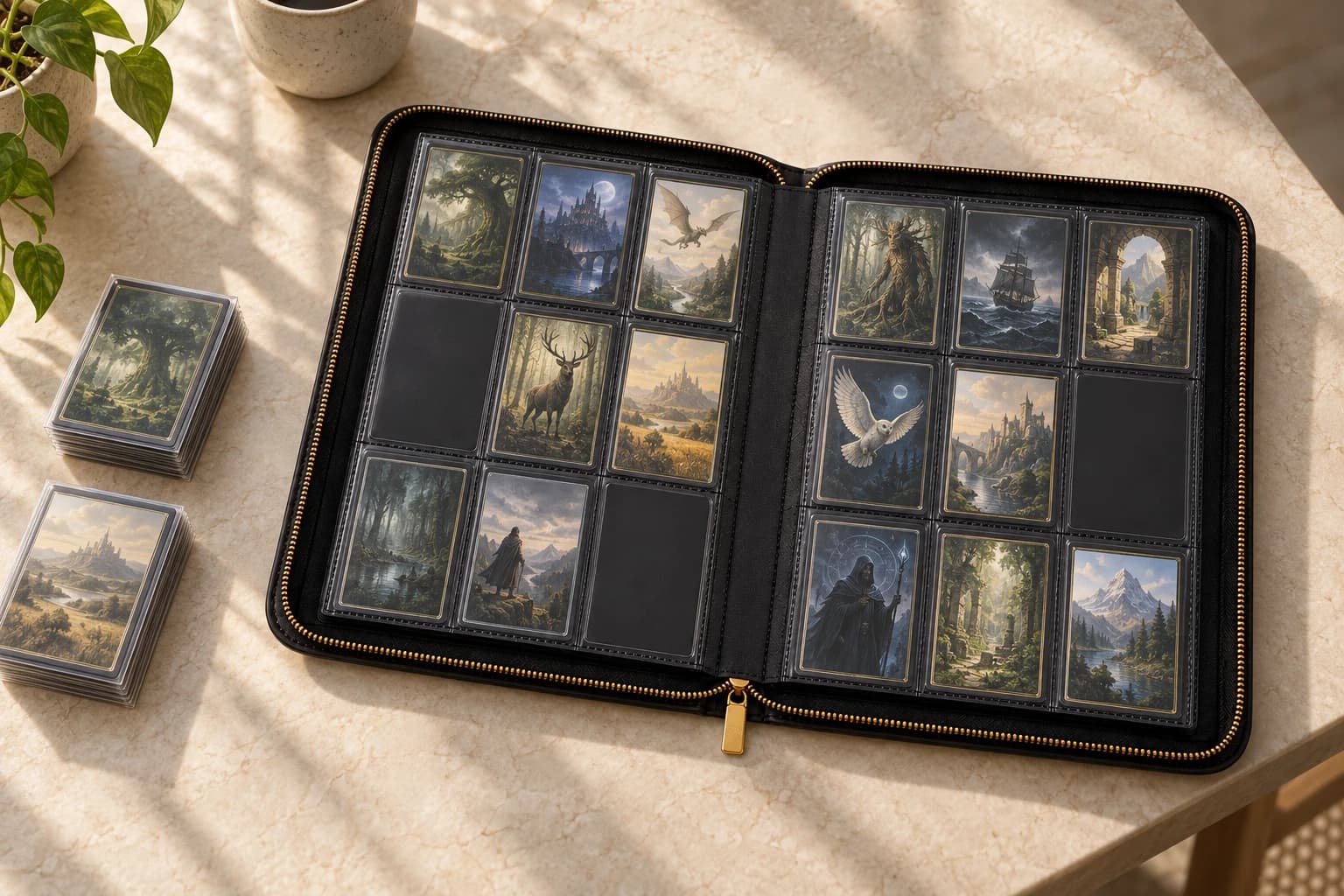
Binders are useful here because they let a collection be seen while still being closed and stored most of the time. A well-made binder turns viewing into a controlled moment: open, browse, close, return to the shelf. That is very different from leaving loose cards out all day.
For cards you want to revisit often, a ringless binder with archival side-loading pages is usually kinder than a stack of loose holders on a desk. See how to store a card collection in a binder for the storage side of that decision.
A simple display setup
For most collectors, the safest display setup looks like this:
- A shaded interior wall or shelf, away from windows and heat sources.
- A sleeved card inside a stable holder, frame, binder page, or slab.
- UV-filtering glass or acrylic if the card is framed.
- No adhesives touching the card or holder.
- A rotation habit, so the same card is not exposed for months or years.
- Dark, stable storage for the rest of the collection.
Display should be temporary. Protection should be permanent.
Cards are collected to be enjoyed, and part of that enjoyment is seeing them. The question is not whether to display them. It is whether the display respects the object. Control the light, avoid pressure, keep the climate steady, and rotate the cards you show. Then display becomes part of collecting rather than the slow reason a card loses what made it worth displaying in the first place.