How to organize a trading card collection across multiple binders
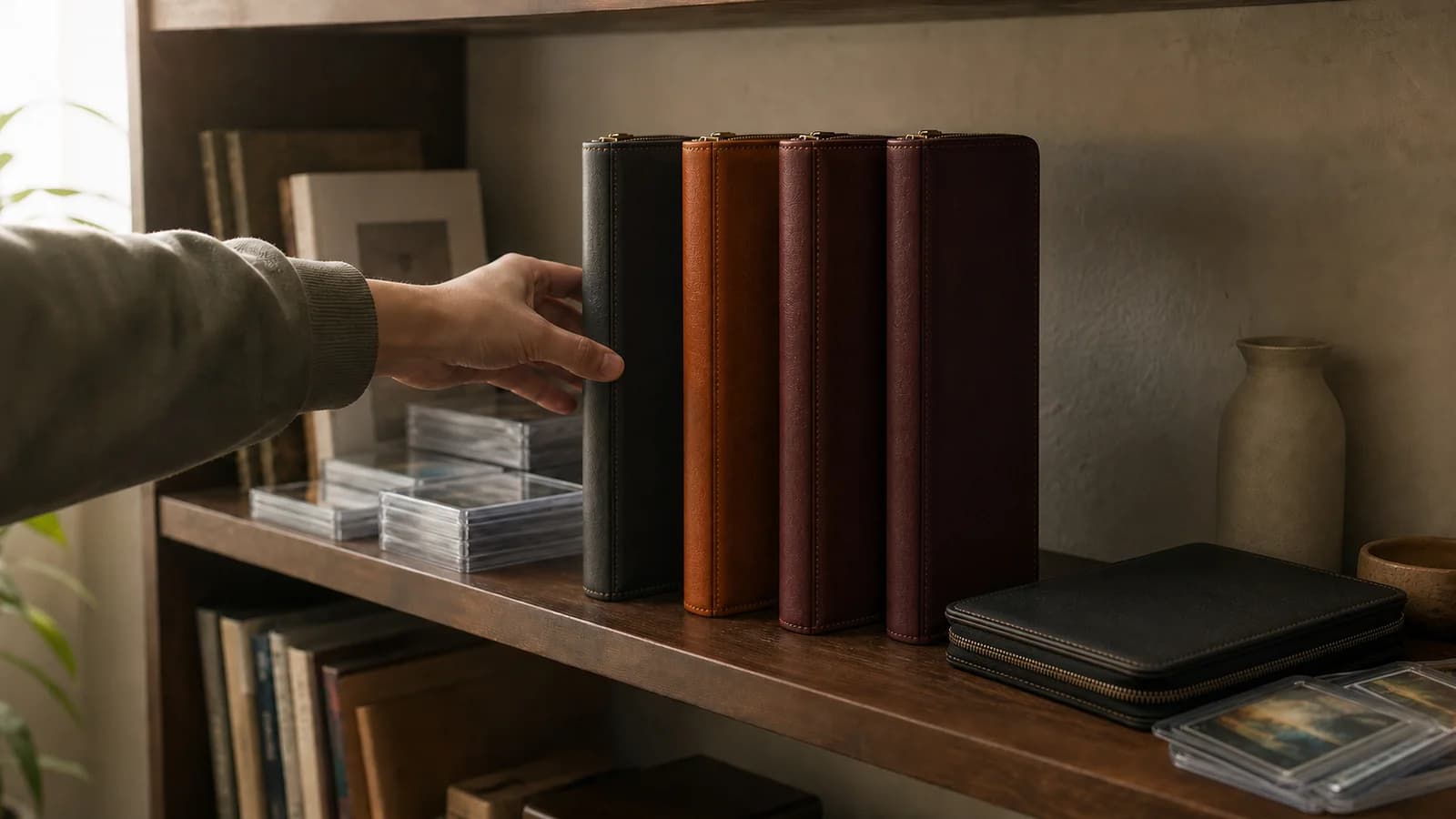
A card collection rarely stays in one binder. One game becomes two. A favourite set grows into a master set. Valuable singles need a different home from ordinary cards. Before long, the shelf holds several binders and the question changes from “Where should this card go?” to “Which binder did I put it in?”
The answer is not a more complicated storage system. It is giving every binder one clear job.
Start with the way you actually collect
Do not begin by buying labels or building a spreadsheet. Begin by looking at the cards you return to most often.
Most collections naturally separate in one of four ways:
- By game or intellectual property: one binder for each card game, series, or world.
- By set: one binder for a complete or nearly complete release.
- By theme: one character, player, artist, team, era, or type of artwork.
- By purpose: a viewing binder, a trade binder, a master-set binder, or a smaller binder for favourite cards.
Choose the division that makes finding a card feel obvious. If you collect several games, separating by game is usually the cleanest first layer. Inside each game, you can then divide by set or by the kind of collection you are building.
The system should reflect your habits, not someone else’s idea of a perfect archive.
Give every binder one sentence
If you can describe a binder in one sentence, it has a clear role.
“This is my complete set binder.” “This holds favourite characters across different releases.” “This is the binder I take to trading nights.” “This is everything I pulled from one era.”
That sentence becomes the rule for what enters the binder. A card either belongs or it does not. Without a rule, binders slowly become mixed storage: part set, part favourites, part duplicates, and part cards placed wherever a pocket happened to be empty.
Mixed binders are not inherently wrong. A personal binder can be one of the most enjoyable parts of a collection. It simply needs a point of view. Our article on what makes a trading card collection feel personal explores that idea in more detail.
Separate active collections from finished ones
An active binder changes regularly. Cards are added, empty positions are filled, and sections may need to move. A finished or slow-moving binder is opened to be enjoyed, but its order rarely changes.
Keeping those two states separate makes both easier to manage.
An active set binder needs spare pockets and a little flexibility. A finished collection can be arranged more tightly because the structure is unlikely to change. If a completed set continues receiving promotional cards or late variants, reserve a final section for them rather than rebuilding the entire sequence every time.
This also helps decide which binder should be easiest to reach. Active binders belong at a comfortable height on the shelf. Finished or reference collections can sit beside them without being handled every week.
Leave room before you need it
A binder that is technically not full can still be functionally full. If every pocket is assigned and a new card belongs near the beginning, one addition may require moving dozens of cards.
Leave planned space where growth is likely:
- Empty pockets after an incomplete set.
- A spare page face between major sections.
- A final section for promotional cards and unexpected variants.
- Enough overall capacity that the binder closes without pressure.
Empty pockets are not wasted space. They preserve the logic of the collection.
If one set is likely to become a master set, calculate its needs before it spreads across several binders. Our guide to planning a master set in a 360-pocket binder shows how to count the base set, variants, promos, and growth space before filling the first page.
Use a simple location record
Once a collection reaches several binders, memory becomes unreliable. You do not need to catalogue every common card, but you should be able to locate important sections quickly.
A note on your phone or a small spreadsheet is enough:
- Binder name or number.
- Game, set, or theme.
- Card-number range or section.
- Important cards stored inside.
- Missing cards you are still looking for.
- Date last reorganized.
Keep the language plain. “Binder 3 — One Piece sets, early releases” is more useful than an elaborate code you will forget.
For the physical shelf, use a removable tag beside the binder, a shelf card, or a simple location order. Avoid permanent adhesive labels on a finished exterior unless you know they can be removed without changing the surface.
Keep trade cards and bulk out of the viewing collection
Duplicates grow faster than almost every other part of a collection. If they share the main binder, they consume space and blur the sequence you actually want to see.
Keep trade cards in a dedicated binder only if browsing them is useful. Ordinary duplicates and bulk are usually easier to manage upright in correctly sized card boxes. Valuable duplicates can receive the same protection as other valuable singles without needing to occupy the set binder.
This gives the main collection room to breathe. A binder should present a collection, not absorb every card you own.
Know when to split a binder
Split a binder when its purpose has become unclear, when the pages no longer turn comfortably, or when new additions repeatedly force large reorganizations.
Good dividing points include:
- Base set in one binder; parallels and promotional cards in another.
- One game per binder instead of several games mixed together.
- Finished sets separate from active sets.
- Favourite cards separate from trade inventory.
- Older eras separate from current releases.
Do not wait until the binder is under strain. A second binder is not evidence that the first system failed. It often means the collection developed enough identity to deserve clearer sections.
Keep the physical routine consistent
Use the same basic handling rules across every binder: clean, dry hands; correctly sized sleeves; one card per pocket; and a clear table when moving cards. Fixed side-loading pages help keep the orientation familiar from one binder to the next.
Store binders upright with support on both sides, or flat on a clear shelf. Do not leave one leaning under the weight of the others. For a fuller storage routine, see how to store a card collection in a binder.
A good multi-binder system does not make the collection feel larger. It makes every part easier to find and enjoy.
The goal is not perfect administration. It is knowing where a card belongs, where to find it, and where the collection has room to grow. When every binder has a clear role, owning six can feel simpler than owning one without a plan.