Ring binder vs fixed-page binder: which is better for trading cards?
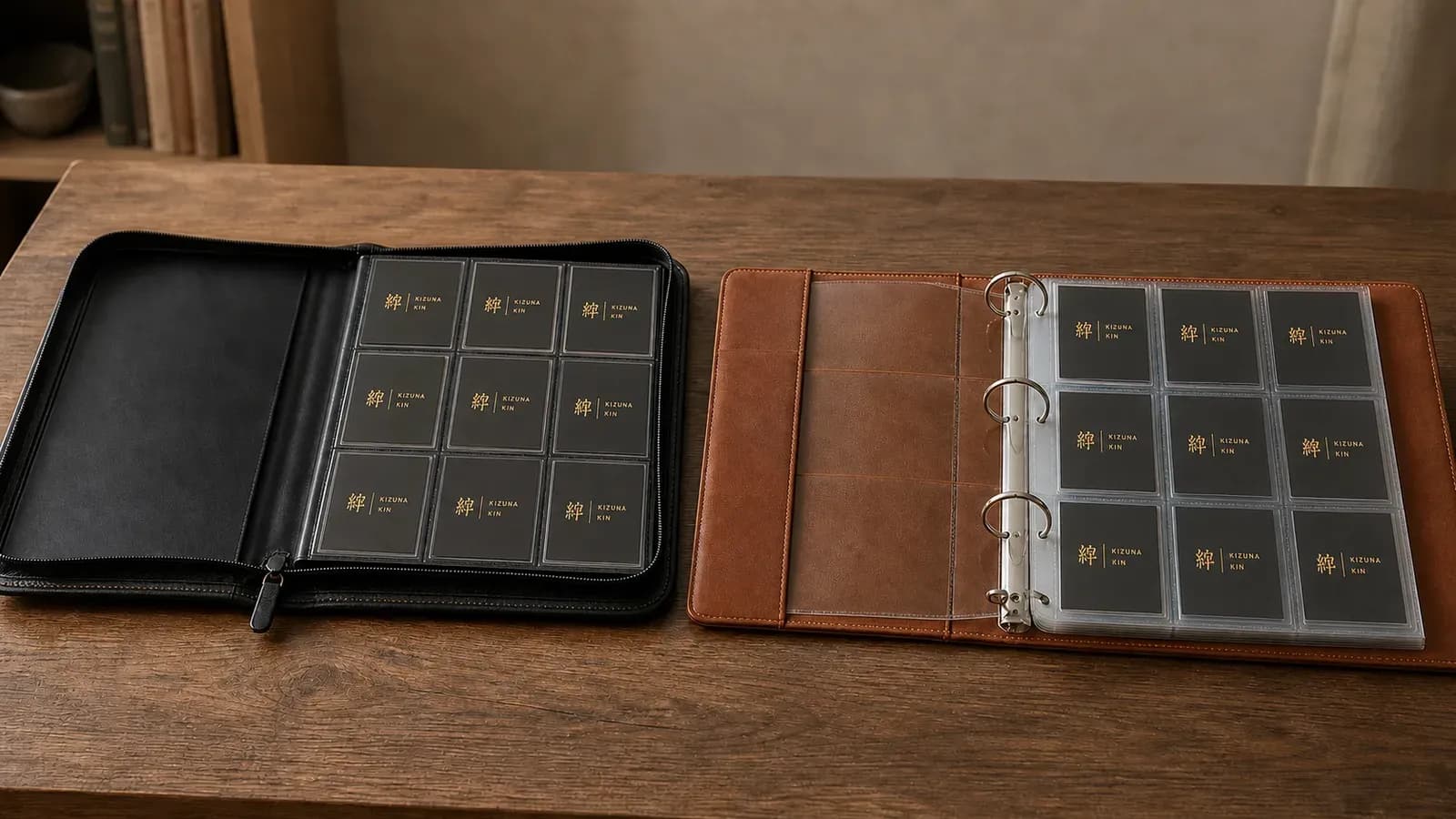
Ring binders and fixed-page binders can hold the same nine-pocket card layout, but they behave differently every time a page is added, turned, moved, or stored.
A ring binder treats pages as replaceable parts. A fixed-page binder binds them into one structure. Neither format solves every collecting problem. The better choice depends on how often the collection changes and how much you value flexibility over a controlled page block.
This is also a different decision from choosing between a standard binder and a toploader binder. That comparison is about whether each card sits inside a rigid holder. You can read it in binder vs toploader binder.
How a fixed-page binder works
In a fixed-page binder, the pocket pages are sewn, welded, or otherwise bound into the spine. They cannot be opened out of a ring mechanism or replaced individually.
That creates a predictable object:
- Page order stays attached to the binder.
- There is no metal mechanism beside the cards.
- The page block has a fixed maximum capacity.
- Pages cannot be accidentally removed or inserted on the wrong side of a ring.
- The binder can be built with a fitted zip closure around the complete page block.
For complete sets, character collections, artist collections, and binders opened mainly for viewing, that predictability is useful. The collection reads continuously from the first page to the last.
The trade-offs of fixed pages
Fixed does not mean inflexible in every sense. Cards can still be rearranged. What cannot change is the number or order of the page leaves themselves.
That creates three limitations:
- A damaged page is difficult or impossible to replace by itself.
- You cannot insert a new page in the middle of a set.
- Once the binder is full, expansion requires another binder rather than another page.
For that reason, capacity should be planned before a large set is loaded. If you are building a master set, our guide to planning one in a 360-pocket binder explains how to count variants and reserve growth space.
How a ring binder works
A ring binder holds removable pocket pages on a metal mechanism. Open the rings and a page can be added, replaced, or moved to another section.
Its main advantages are flexibility:
- Pages can be reordered without moving every card.
- A damaged page can be replaced.
- Different compatible page formats can live in one binder.
- A growing set can receive a new page in the correct position.
- Sections can be removed or archived separately.
This is useful for collections that change constantly, reference inventories, trade stock, and sets whose final size is not yet known.
The trade-offs of rings
The metal mechanism introduces its own handling routine. Rings need to remain correctly aligned and fully closed. If a ring develops a gap, pages can catch or slip as they turn.
Pages also need enough room to move around the rings without bunching. Adding pages until the covers barely close does not create safe extra capacity. It creates pressure and makes page turning less controlled.
When using a ring binder:
- Open and close the mechanism using its tabs rather than pulling directly on the rings.
- Check that all rings meet cleanly before turning pages.
- Keep page edges and cards away from the mechanism while closing it.
- Do not load beyond the binder’s practical page capacity.
- Support the page block when the binder is carried or stored upright.
A well-made D-ring format is often easier to manage than a small round-ring format because the page block can rest along a flatter side. Ring shape does not correct weak alignment, poor pages, or overfilling, but it can make the stored stack more orderly.
Page material matters in both formats
A fixed-page binder is not automatically archival, and a ring binder is not automatically unsafe. The page material, pocket fit, seams, and overall construction still matter.
Look for pages described as PVC-free and made for trading-card storage. Sleeve cards before placing them in the pockets, use one card per pocket, and avoid a fit that bows the card or catches its corners.
“Acid-free” and “PVC-free” describe different things. Our reference on PVC-free vs acid-free card storage explains what those terms do and do not tell you.
Which is better for complete sets?
A fixed-page binder is usually the more natural format when:
- The final collection fits within a known capacity.
- Page sequence matters.
- Cards will be viewed more often than reorganized.
- You want the binder to remain one self-contained object.
- You prefer not to have metal rings inside the cover.
A ring binder becomes useful when the set list is unsettled, pages need to be inserted later, or several kinds of pocket page must live together.
The choice is not only about protection. It is about how the collection changes.
Which is better for trade cards?
Trade collections change frequently. Cards enter and leave, categories shift, and an empty section may need to move.
That makes a ring binder practical for some traders, especially when pages are regularly reordered or replaced. A smaller fixed-page binder can still work well when the trade selection is curated and the cards are simply replaced within existing pockets.
If a trade binder travels often, consider the whole object: closure, cover structure, page support, weight, and how it behaves in a bag. Flexibility is useful only if the binder remains easy to handle.
Which is better for long-term use?
Long-term care depends more on materials, loading, handling, and the storage environment than on one mechanism alone.
A fixed-page binder removes ring alignment from the routine and keeps its capacity honest. A ring binder makes individual pages replaceable and lets a collection adapt. Both should be kept away from direct sun, heat, damp, leaks, and unsupported leaning.
The right question is not “Which binder is safest forever?” It is “Which construction introduces fewer problems for the way I use this collection?”
A practical way to choose
Choose a fixed-page binder if you want a set object with predictable capacity, continuous pages, and no need to add or remove page leaves.
Choose a ring binder if page-level flexibility is essential and you are comfortable checking the mechanism, controlling capacity, and supporting removable pages.
Fixed pages favour continuity. Rings favour change.
Both formats can be useful. What matters is matching the construction to the collection instead of asking one binder to do every job.